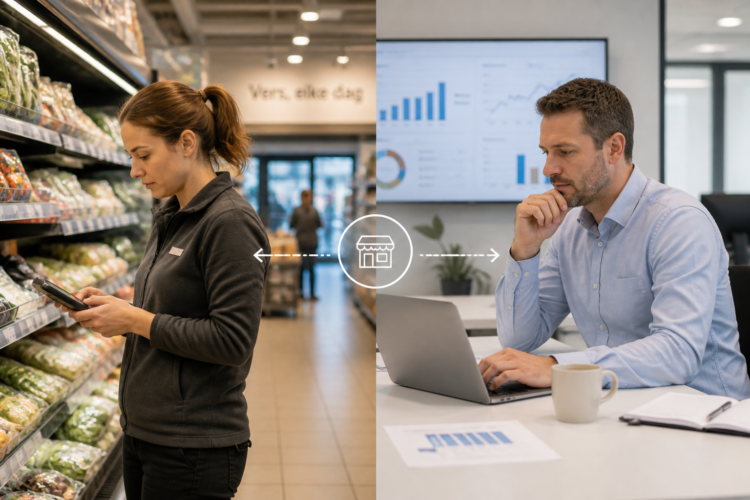
In many organizations, the gap between corporate headquarters and day-to-day operations goes unnoticed.
Everyone works toward the same goal in their respective roles. At headquarters, the focus is on management, consistency, and transparency. On the operational side, the goal is to implement these plans on a daily basis in a constantly changing environment. Both perspectives are understandable. But precisely because they coexist, tensions can arise.
Within an organization, there are often several competing interests at play.
At headquarters, the emphasis is on the big picture. The focus is on key performance indicators that are important company-wide, on consistency across stores and regions, and on creating a comprehensive overview. Insights and integrations help monitor performance and make adjustments as needed.
In day-to-day operations, the focus is on the here and now. The goal is to keep daily operations running smoothly: ensuring adequate staffing, responding to high demand, and making sure customers are served. Decisions are made constantly, often under time pressure.
Both perspectives are necessary. They complement each other but emphasize different aspects.
At the same time, all of these interests are aimed at the same goal: successful store performance.
That may sound obvious, but in practice, this isn't always the starting point for day-to-day management. What helps one side achieve this goal may actually be perceived as a distraction by the other side.
A decision that ensures greater control and consistency may be perceived in the workplace as a restriction on entrepreneurial freedom. Conversely, an adjustment at the operational level may make sense in the short term but may not fit well within the broader framework.
Not because it's contradictory, but because it's viewed from a different perspective.
The challenge lies not in the existence of differing interests, but in how to deal with them. As soon as these interests are organized too separately from one another, friction arises. Then planning becomes something you have to deviate from, rather than something that helps. Or insights are viewed as a means of control rather than as support.
Even though they essentially serve the same purpose.
The key is to focus on this common ground, while remaining aware that different interests are at play. Not by ignoring these interests, but by bringing them together in a way that allows them to reinforce one another and cause as little distraction as possible.
Bridging this gap begins with a shared starting point. When headquarters, planners, and stores all build on the same real-time insights, there is more room for local adjustments within a central framework. This not only makes decisions more strategically sound but also makes them easier to implement in the stores.
In practice, this means that store managers and corporate headquarters work with the same data and goals. This fosters a better understanding of local conditions, while allowing companies to maintain control over productivity, service, and costs.
Workforce management plays an important role here.
Not only in creating a sound plan, but also in taking into account all the interests involved. From strategic management and insights at headquarters to flexibility and autonomy at the operational level. So that what is important to one party does not come at the expense of another—but rather contributes to the same outcome.
At R&R, we see this in action every day. Bringing together the headquarters and the operational side of the business requires not only insight but also a way of working in which different interests reinforce one another rather than hinder each other.
That is why we design our workforce management system to support both.
On the one hand, through intuitive software designed specifically for the retail sector that covers every level of a business—from strategy to day-to-day operations. This creates a unified, holistic view of performance trends, and decision-making is based on the same insights. On the other hand, through our experts, who help companies actually put these insights to use and strengthen collaboration among all stakeholders.
In this way, we ensure that different interests are not organized separately from one another, but are integrated into a unified management framework.